More than a game: SNC students uncover the impact of sporting events on local economy
For more than 100 years, the greater Green Bay area has been known as the home to the most storied franchise in the National Football League. The Green Bay Packers put the region on the map, but over the years, several other teams and major sporting events have also helped position Northeast Wisconsin as a sought-after destination for large athletic gatherings. From PGA Championships to the NFL Draft, what kind of revenue opportunities have these events brought to local businesses? How do they influence long-term tourism and regional growth? This semester, two St. Norbert College students were tasked with uncovering the answers to those questions.
Casey Mayew ’27 and Jaden Propson ’27, along with dean of the Donald J. Schneider School of Business & Economics Kevin Quinn, presented their research findings at the biannual Economic Intel Forum last month. The forum explores timely economics-related topics and their impact on Wisconsin. It is made possible through a collaborative partnership with Associated Bank, New North, Inc., the Wisconsin Department of Revenue and St. Norbert College.
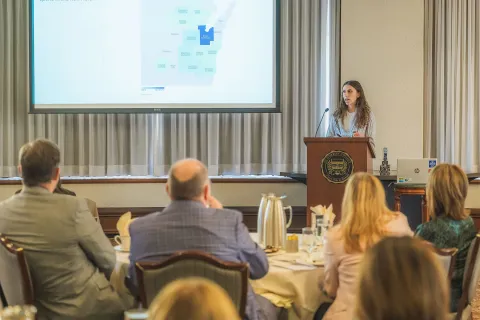
To set the stage for the presentation, John Koskinen, chief economist for the Wisconsin Department of Revenue, provided an overview of the current state of the economy, with a particular focus on Northeast Wisconsin. He shared key data points, including that the state has the eighth-lowest unemployment rate in the nation and that unemployment compensation claims are at a 25-year low, while many other states are seeing increases. Koskinen also highlighted that Wisconsin is low in debt, has a very low delinquency rate and is among the lowest states for past-due loans. As the first slide of the presentation noted, “Wisconsin and the New North are doing fine.” Putting all of this complex economic data into a comprehensible form is a critical skill to develop.
“The most important part of our process was the ability to take content that we learned in class with Dr. Quinn, and not just connect it to real world ideas, but analyze and interpret that information,” Propson said. “Dr. Quinn did a remarkable job of explaining how economic impact studies work as well as showing the importance of building organized data to present a storyline.”
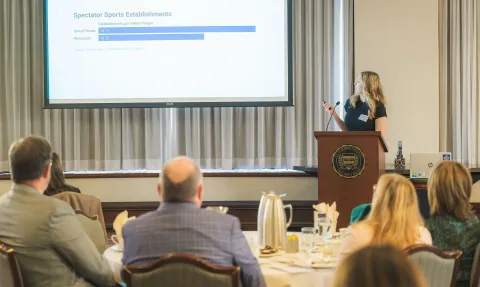
The presenters then shifted their focus to the main topic of analysis: the economics of sports. Their findings showed that with three professional sports teams, Wisconsin is among the most intensive states for the sports industry. Beyond driving spending within local communities, these teams also provide significant employment opportunities. While Wisconsin has fewer establishments per million people than the national average, it boasts higher sports payroll per capita and more employees per million people due to its population, when compared to other states with three major sports teams. Although the New North region is home to only eight of the state’s 61 commercial spectator sports establishments, it accounts for nearly one-third of Wisconsin’s spectator sports employees.
“It’s fascinating to look at the data and see how many industries you may have never even considered are actually affected by spectator sports.”
Casey Mayew ’27
It’s not every day that the NFL Draft comes to town. As the Packers reported this summer, the draft exceeded economic impact projections, bringing in nearly $73 million to Brown County alone. Despite the draft taking place eight months ago, it remains top of mind for many business leaders in the region, fueling continued momentum moving forward.
“Of course, the Packers and the other commercial spectator sports businesses in our region create lots of jobs and contribute significantly to the area’s economic activity, but special events like the Draft, EAA and PGA Tour events bring in lots of folks,” said Quinn. “They don't only spend their money here, but they all become ambassadors for Northeast Wisconsin’s quality of life. That gets the attention of other businesses and industries considering relocating here.”
While revenue, job creation and tax dollars can be measured, the presenters emphasized the unquantifiable value these events generate. It’s something the students found especially compelling to analyze.
“Spectator sports can unite a community, and that is evident in Brown County.”
Jaden Propson ’27
“Where in our lives do we find ourselves sitting next to someone with very different personal backgrounds, political views, family circumstances, etc. all rooting together in common?” Quinn asked. “Community is the glue that holds a society together, and it is obvious that we have less and less that binds diverse people together. Sports lets us connect with others we might not ever talk to.”
Beyond the data and economic indicators, the forum underscored the value of experiential learning and the opportunity for students to apply classroom knowledge to real-world questions. For Mayew and Propson, the research process itself proved just as impactful as the findings they presented.
“The most valuable skill I gained through participating in this research presentation was the analysis,” Propson said. “Being able to apply ideas and theories learned in the classroom to the data has been such a rewarding experience.”
Mayew echoed that sentiment, pointing to the importance of effective communication alongside technical skills. “The most valuable skill I learned through this research and presentation was how to use data visualization to tell a compelling story,” Mayew said. “With the guidance of Dr. Quinn and a great deal of help from Jaden Propson, we were able to take our findings and figure out how to make the information digestible to anyone.”
For Quinn, the presentation reflected exactly what the Economic Intel Forum is designed to foster: student curiosity, collaboration and real-world engagement. “Students are the energy and lifeblood of the college. They are the reason I am here,” Quinn said. “The best part of my job is helping students find and participate in real-world opportunities. We attract absolutely wonderful young people, and I am constantly in awe of what they can do. As I said at the presentation, the future is in good hands with young people like Casey and Jaden.”
Information about future Economic Intel Forums will be shared as it becomes available.